

Early physiological insight for austere care, triage, and prolonged field monitoring
PhysioSense helps defense and government partners extract earlier, more interpretable signals of physiological instability from common pulse waveforms in austere, forward, en route, and prolonged care environments. Using wearables, patient monitors, and related waveform sources, the platform supports triage, resuscitation prioritization, delayed deterioration monitoring, and low-burden physiological assessment when conventional vital signs may appear stable.
Conventional field monitoring often misses early deterioration
- Heart rate, SpO2, and blood pressure may remain clinically acceptable during early blood loss, shock evolution, or delayed neurological deterioration
- Austere, forward, and prolonged field care settings need practical noninvasive tools that provide more than conventional vital signs alone
- Heat strain, burn resuscitation, and TBI-related deterioration can evolve over time with limited access to imaging or invasive monitoring
- Operational medicine requires low-burden monitoring approaches that can support triage, trend assessment, and transport decisions across Roles of Care
Add a deeper physiological layer to common pulse-waveform monitoring
PhysioSense transforms pulsatile waveforms from wearables, patient monitors, patches, and related sensing systems into interpretable physiological descriptors that can be tracked over time. The platform helps surface changes related to vascular load and compliance in settings ranging from far-forward triage and en route monitoring to prolonged field care and institutional military medicine.
Vascular Radar brings interpretable trend monitoring to austere and prolonged care
PhysioSense Vascular Radar is being developed as a software layer that converts peripheral pulse waveforms into an interpretable view of vascular state and hemodynamic instability. It is intended to help care teams see meaningful change over time when standard vital signs may remain deceptively stable.
- Supports early recognition of evolving instability from common pulse-waveform sources
- Helps visualize trend direction, not just single-point measurements
- Intended for Roles 1 through 3, including far-forward triage, en route monitoring, and prolonged field care
- Built as a sensor-agnostic software platform spanning wearables, monitors, and camera-based inputs
Operational monitoring beyond HR, SpO2, and BP alone
A defense-relevant visualization layer for early hemodynamic instability, trend assessment, and monitoring in austere or resource-limited care environments.
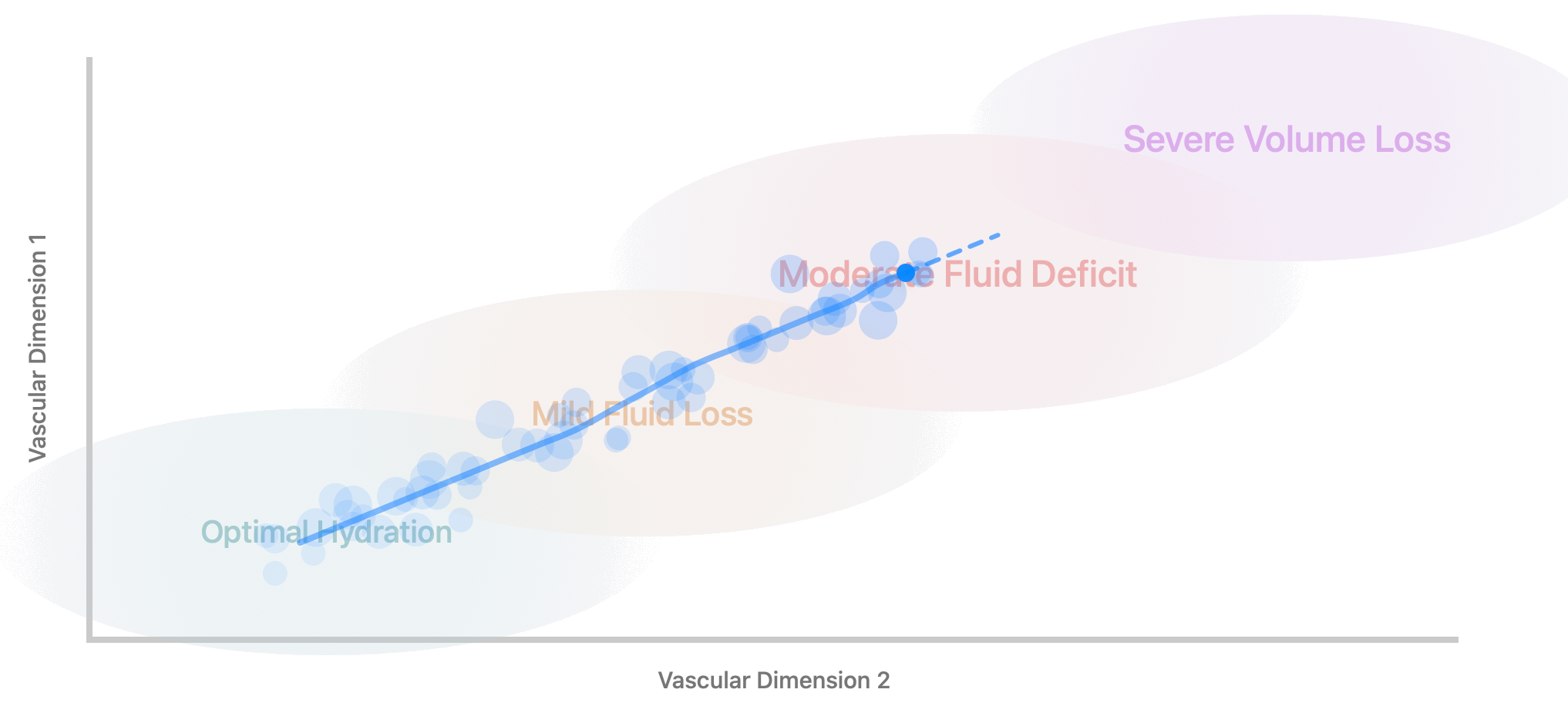
Where PhysioSense and Vascular Radar can add operational value
We support use cases in early blood-loss detection, shock differentiation, delayed TBI deterioration, burn resuscitation monitoring, and austere or prolonged field care workflows.
Early Hemorrhagic Hypovolemia Detection
Peripheral pulse-waveform analysis can reveal blood-loss related physiologic change earlier than conventional field vitals alone, supporting earlier triage, monitoring, and resuscitation prioritization in austere or prolonged casualty care environments.
Shock Differentiation in Austere Settings
Waveform-derived physiologic signatures may help distinguish hemorrhagic, septic, and cardiogenic shock patterns when standard vital signs are limited or diagnostically masked, supporting more informed resuscitation decisions in forward and semi-fixed roles of care.
Delayed TBI Deterioration Monitoring
Continuous pulse-waveform analysis may help identify evolving vascular signatures associated with delayed neurological deterioration, offering a potential warning layer for head-injured casualties when neuroimaging and invasive monitoring are unavailable.
Burn Resuscitation and Triage
Continuous noninvasive pulse-waveform monitoring may help identify the transition from early vasoconstricted burn shock toward later distributive physiology, supporting triage, resuscitation guidance, and monitoring when MAP and other standard measures remain unremarkable.
Far-Forward, En Route, and Prolonged Field Care
Vascular Radar is intended for Roles 1 through 3, especially far-forward triage, en route monitoring, prolonged field care, and resource-limited stabilization where common pulse-waveform sources may be available but advanced diagnostics are not.
Readiness, Recovery, and Operational Strain
Repeated waveform-based assessments can also support programs focused on training load, recovery, and physiological strain over time, though the strongest current defense-facing evidence is in austere monitoring and casualty-care scenarios.
Defense-aligned research supports the operational use cases
PhysioSense research and product development align closely with military-relevant monitoring needs, including early blood-loss detection, shock differentiation, delayed deterioration monitoring, and burn resuscitation support.
Early Hemorrhagic Hypovolemia Detection
Shock Differentiation in Forward Trauma Care
Delayed TBI Deterioration and Burn Resuscitation Monitoring
How PhysioSense works with defense and federal partners
Technical Briefing & Operational Review
We begin with the operational context, target use case, care environment, and available sensors to identify where PhysioSense and Vascular Radar can add the most value.
Pilot, Proposal, or Feasibility Planning
PhysioSense can support technical concept development, proposal collaboration, early feasibility work, and pilot planning for casualty care, austere monitoring, readiness, or field-informed physiological assessment programs.
Prototype or Operational Evaluation
Programs can progress into structured evaluations in training, field, en route, institutional, or distributed monitoring settings to assess workflow fit, signal value, and deployment practicality.
Expansion and Mission-Specific Adaptation
Mature efforts can expand into broader operational workflows, partner platforms, government-funded prototype programs, or mission-specific monitoring implementations depending on results.
Operationally relevant technical flexibility
- Supports wearables, patient monitors, patches, and related pulse-waveform sources
- Applicable to austere, forward, en route, institutional, and prolonged-care monitoring contexts
- Built for trend assessment and early instability recognition rather than only threshold-based alerting
- Compatible with phased research, prototype, and pilot-oriented government partnership models
- Well suited for operational medicine, casualty care, and defense research collaborations
- Backed by expertise in physiological signal interpretation, waveform-based modeling, and critical-care relevant monitoring
Interested in a defense or government collaboration?
Explore how PhysioSense and Vascular Radar could support casualty care, austere monitoring, or operational medicine programs.
Contact Us